
The Canadian Exercise Kate & The Assault Training and Development Centre, 79th Armoured Division at Burton upon Stather
Why Burton Stather?
The Burton Stather site was chosen as its position lent itself to secrecy and the River Trent at this point, with its muddy banks and silted tidal flow it very closely matched that of European rivers such as the Seine and Rhine.
August 1942
Operation Jubilee (Dieppe Raid)
During the Allied Forces ill-fated water-based raid on Dieppe the 2nd Canadian Division took severe losses, this included a tank regiment and was supported by the Royal Navy and the RAF.
The objective was to capture the port and hold it for a short period.
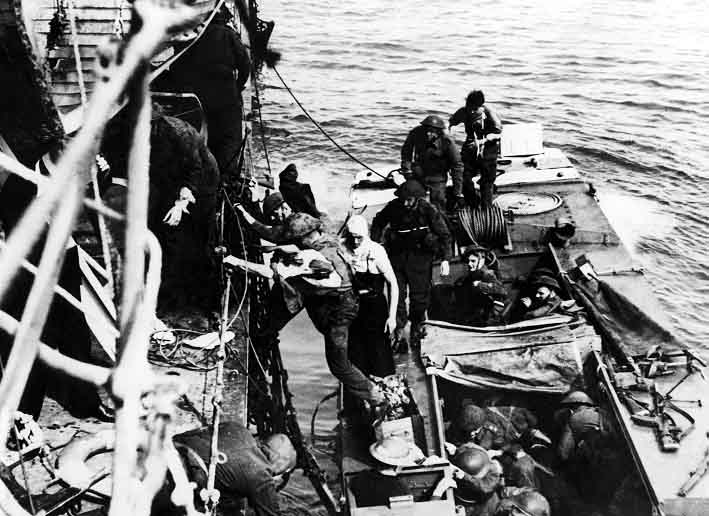
c. Service historique de la Defense
Most of the troops were Canadian and approximately 50% of all those who took part were either killed, captured or wounded.
Morale was low afterward and there were many changes – from commander to kit.
1943
It took a year for the Canadian Division to rebuild itself.
Meanwhile, with Prime Minister Winston Churchill’s backing General Sir Alan Brooke, Chief of the Imperial General Staff decided to create special units and assigned responsibility to armoured warfare expert Percy Hobart. Brought out of retirement, he was charged with the development of vehicles and training crews.
Top Secret Training Centres
The Duplex Drive Tanks had an inflatable floatation device designed by Hungarian designer Nicholas Staussler which provided buoyancy (based on displacement theory) and propellers for propulsion when water borne. Fritton Lake in Norfolk became home to the Freshwater Training Wing, whilst Stokes Bay, Gosport, Hampshire was the Saltwater Training Wing. Eventually over 1,200 Canadian, American and British men passed through these Top-Secret training centres.
January 1944
By early 1944 Major General Sir Percy Hobart was able to demonstrate to American General Eisenhower and British General Montgomery a brigade each of the Duplex Drive Tank, Crab Mine Clearers, AVRE Tanks and a regiment of Churchill Crocodile Flame Throwers Tanks – Hobart's Funnies
At the end of January 1944
1st Canadian Army was issued a directive from HQ 21st Army Group (a British HQ controlling the British 2nd Army and 1st Canadian Army) and Engineer planning began that same day.
Excerpt from Report 66 DeclassifiedThe role of First Canadian Army will be to land [in Normandy] after the Second British Army.
This was to be called Operation Axehead.
28th & 29th March 1944
In Preparation
46 (E) Infantry Brigade and R.E. units, the 1st Canadian Army Troop Engineers settled down in the Goole and began taking preliminary instruction in watermanship.
Exercise Oyster III.
took place on The River Ouse, in Yorkshire, just 7 miles from Burton upon Stather as the crow flies.
11th of April 1944
HQ 1st Canadian Army issued a directive to 2nd Canadian Corps to employ the 2nd Canadian Infantry Division in conjunction with specially trained engineers to participate in planning a Brigade Assault.
This exercise was known as Kate and is what brought units of the 2nd Canadian Army into the Burton upon Stather area.
28th April 1944
At Burton Upon Stather - Exercise Kate (Crossing A Tidal Estuary)
It was a series of brigade and battalion exercises using storm boats. The items of special equipment to be used on Kate were:
- Storm Boats
- A power-driven plywood vessel 20 feet long, with capacity for 12 armed passengers or 3000 pounds of freight.
- Rafts
- Sometimes referred to as Pontoons, were erected by engineers on the spot and used to move heavier equipment. i.e. at least 2 x Bren carriers or 1 60cwt truck. Each raft was propelled by 4 outboard motors.
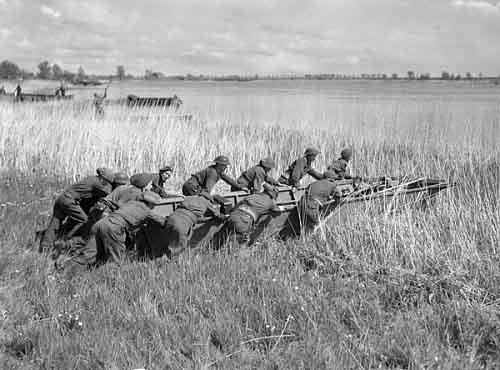
Canadian troops taking part were:
- Units of 1st & 2nd Army Troop Engineers
- Royal Regiment of Canada
- Royal Highland Light Infantry. Regt C.
- Essex Scottish
- R.H.C. (Royal Highlanders of Canada)
- Calgary Highlanders
And the following supporting arms and services:
- Elements of 2nd Anti-Tank Regt. Royal Canadian Army
- Elements of Toronto Scottish Regiment (Machine Gun)
- 5th Infantry Brigade Company Royal Canadian Army Service Corps
- 45th General Transport Company Royal Canadian Army Service Corps
- Three platoons of 85th Bridge Company R.C.A.S.C.
Air Support in the form of smoke was provided by Typhoons of 266 Sqn RAF. Based at RAF Duxford and re-equipped with the Hawker Typhoon. During April – May 1944 the squadron was stationed at Snaith during the smoke exercises and briefly became part of Second Tactical Air Force, No.146 Wing.
May 1944
The Assault Training and Development Centre (River Crossing) 79th Armoured Division arrives at Burton upon Stather.
Already having Fresh Water and Saltwater Training Centres the Directorate of Military Training was charged with assisting the newly formed unit known at the Assault Training and Development Centre (ATDC) to find a suitable site for river crossing training.
The ATDC was tasked to train instructors and squadrons to cross rivers in Duplex Drive Amphibious Tanks. Men in this unit were a mix from other regiments chosen it would seem for their skill sets.
For example; John Porteous an Argyll and Sutherland Highlander trained as a shallow water diver with further intensive training at HMS Dolphin, Gosport.
Dave Gibb and Gordon Darkie
Stone both Tank Regiment Mechanics, Johnny Lawn Highland Light Infantry, Lance Corporal Humphries was 61st Reconnaissance Unit.
It was hot weather and Sally Robinson nee Bull recalled the log line of military vehicles lining Stather Road, her mother busy making tea for the thirsty soldiers having to resort to jam jars when the cups and mugs ran out.
An Artisan Work Company of the Royal Engineers began work creating an, initially temporary, Summer Camp for amphibious tank training for Axehead only.
Housed under canvas at Winteringham Camp to begin with eventually some men were billeted under canvas on the Burton Stather site whilst others moved to Normanby Hall, the HQ of The Water Assault Unit, when the Canadians left.
Dave Gibb (ex tank Regiment) recalled he and his Sergeant Gordon Darkie
Stone being washed out of their tent by the Aegir and having to move further uphill under the Ash tree as Darkie wanted his team close to their tanks.
A security point was set up by The Ferry House Inn and residents living beyond that had to have an ID pass. Camouflage netting covered the top of Stather Road, an eery feeling for the children walking to school and residents were required to close their curtains should there be any Tank movements off site.
6th May 1944
All the Canadian units that were taking part in Exercise Kate had arrived and became known collectively as Kate Force
.
19th May 1944
Exercise Kate
Continued until 19th May at Battalion level.
20th & 21st of May 1944
The 4th and 5th Canadian Infantry Brigades re-joined 2nd Infantry Division in the Dover-Folkstone area ready for what was to come.
Sally Robinson nee Bull remembers waving the Canadian soldiers off as they marched to Scunthorpe Railways station and hearing farewell shouts of Bye Sister, Bye
.
June 1944
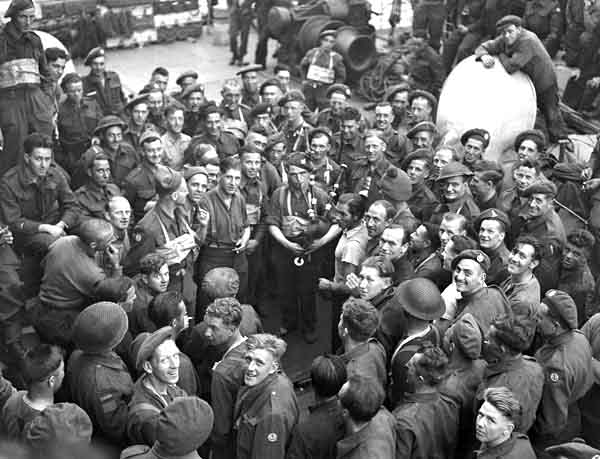
6th June 1944 D–Day - Operation Overlord
The largest amphibious assault in history involving the United States, British, Canadian and other Allies.
7th June 1944
A young flying officer F/O Gordon Smith from RAF Ossington fatally crashed his Miles Martinet into the Burton Stather hillside. Men from The Water Assault and Development Centre are close by and first on the scene. The local Ferry man Roly Readhead and, his later to be son in law, Sergeant Norman Cooper of the Field Security Corps with the ATDC respectfully recover the body and lay it to rest in the Ferry House Inn’s outhouse.
30th June 1944
The course of the war had changed.
The Director of Military Training send a letter to HQ 21st Army Group querying changing from a temporary camp for Axehead only to a semi-permanent camp for training and development.
And so, the ATDC at Burton Stather then became involved in trials and testing some of the more unusual Hobarts Funnies
primarily in ways to manoeuvre the DD Tanks over mud and negotiate fast flowing rivers.
1945
The number of staff was approx. 52 in number although a photograph of the Military Personnel of Assault Training and Development Centre (River Crossing) stood at 55 in 1945.

© IWM (BU 2172)
23rd March 1945, During Operation Plunder
Crossing the Rhine on the night of 23rd March 1945. Twenty-Two Duplex Drive Tanks of the Staffordshire Yeomanry (trained at Burton Stather) successfully swam and were in use before any ferry was able to get other conventional tanks across.
1947
The Burton site remained in military hands until 1947 and was then handed back to the then owners.
The hills returning to their natural state and becoming a playground for the children and walkers once again.
2009
Burton Stather Heritage Group is formed by a group of like-minded people, and we begin to uncover much of the Top Secret
history of our village.
23rd January 2023
The WW2 Amphibious Tank Ramp receives Grade II Listing with Historic England.
Sources
- Historic England - Listing Entry: 1481990.
- The History of the Isle - William Read 1885
- HE Dudley in his ‘History & Antiquities of Scunthorpe & Frodingham’ 1931
- The Second World War journals of Dr. L.G. Alexander
- Report 66 Declassified Ex KATE
- The Duplex Drive Tanks of D Day
- The 1944 Plane Crash - Jamie Whittaker
- No. 266 Squadron (RAF): Second World War - historyof war.org

